Series

27 publications — Series

Publications list

Knowledge networks can be considered as new economic institutions whose main focus is organizing the process of knowledge creation and diffusion. These institutions would play the role of creating and disseminating information and knowledge flows among the regional actors. Based on this recognition, increasing attention has been given to techniques for unveiling these networks and to methods for identifying, within them, the densities corresponding to the most dynamic poles in the cycle of kn…

The development and rapid diffusion of Artificial Intelligence (AI) systems, especially those related to deep learning, generative AI and basic models, raise complex questions regarding the governance of scientific research. The growing integration of AI in many intellectual activities is also profoundly changing the way research is done, intervening in essential phases such as data collection and analysis, theoretical modelling and the publication of results. This means that the discussions …

CNR-DSU Working Paper 4-24

Upcycling and sustainable waste management in the 3R4UB project inUlaan Bator (Mongolia)

2024 - Gaia Daldanise, Francesco Stefano Sammarco

Today's challenges to achieve climate neutrality by 2050 push us to rethink policies, decision-making processes and management models for environmental, social, economic and cultural resources. In this context, the scientific debate highlights interest in the implementation of technological innovation, the contribution of business in developing countries and raising awareness of the SDGs. The main difficulties in the implementation of these topics are encountered in particular in countries, such…

DSU Policy Brief 9-24

Il trasferimento tecnologico alla frontiera della ricerca scientifica

2024 - Maria Carmela Basile, Antonio Cusmà Piccione Cadetto et al.

In recent decades, economic development models have increasingly relied on knowledge. It’s no coincidence that the term “knowledge economy” is used to describe an economic paradigm that, in contrast to last century’s industrialization, evolves towards creating intangible and immaterial value, which underpins products and services. Today more than ever, the generation and dissemination of scientific and technological knowledge are fundamental to competitiveness, understood not only as economic…

The Roskilde Festival, one of Europe's largest and oldest music events, plays a crucial role in transforming the Danish landscape and integrating it into global networks. This study, conducted during a visiting period at the University of Copenhagen, investigates how the festival has driven globalization and reshaped the urban environment, fostering new social and cultural dynamics. It highlights temporary urban planning and cultural production as key drivers of local development, focusing on th…

Intimate Partner Violence (IPV) is a serious and widespread criminal phenomenon that disproportionately affects women. It is recognised as a major form of violence against them. IPV manifests through coercive and violent behaviors perpetrated in a continuous and interconnected manner within an intimate relationship, forming a difficult-to-combat and prosecute pattern of abuse. While an adequate and evolving legal framework exists, implementing effective law enforcement strategies remains challen…

CNR-DSU Working Paper 1-24

Eco-Collaborative Process for Territorial Planning

2024 - Luisa Fatigati

The paper examines actions and tools, elaborated and implemented in the framework of the InkCamp participatory urban planning project and the outcomes therefore achieved by the research (in progress) aimed at developing a context analysis – understood as a set of place and community – for the Municipality of Camposano, in the province of Nola. The engagement actions introduced are aimed at involving the community of Camposano in the drafting process of the municipal urban plan (PUC) initiated…

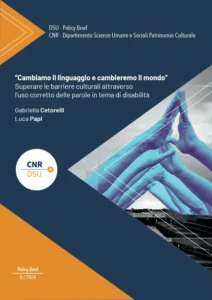
Research leading to the publication of the Manuale di progettazione per l’accessibilità e la fruizione ampliata del patrimonio culturale. Dai funzionamenti della persona ai funzionamenti dei luoghi della cultura (Handbook on Design for Accessibility and Enhanced Use of Cultural Heritage: From Individual Functionings to the Functionings of Cultural Spaces), published by CNR Edizioni and curated by the authors, has generated a true revolution. It is based on all those fa…

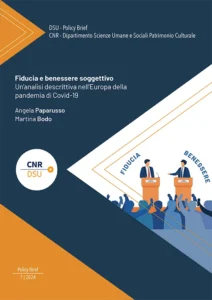
What factors help sustain trust in institutions, science, and the media (so-called vertical trust), as well as the subjective well-being of the population? In this Policy Brief, we aim to answer this question by analyzing individual data from the Eurofound Living, Working and COVID-19 survey and examining the relationship between vertical trust and life satisfaction among European citizens during a period of economic and health uncertainty. During the COVID-19 pandemic, European c…

DSU Policy Brief 6-24

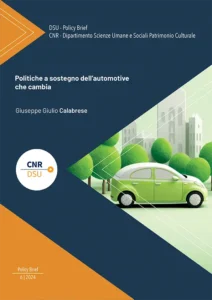
Politiche a sostegno dell’automotive che cambia

2024 - Giuseppe Giulio Calabrese

The search for new propulsion methods for automobiles sparks intense debate across all levels driven by concerns over global warming, pollutant emissions, and the urgent need to sustainably safeguard the automotive industry from newly industrializing countries. The ongoing transformations in the automotive ecosystem require the support and guidance of institutions, especially the central government, to capitalize on opportunities for the entire Italian production chain. Specifically, the role …

The Policy Brief highlights the need to distinguish between different visions of science in public perception: on the one hand, "salvific" science, which can solve any kind of problem; on the other, "tangible" science, which makes our lives easier, more comfortable and healthier. Although in the European context levels of trust in tangible science are on average higher than for salvific science, it is important to point out that in the countries more inclined to a vision of salvific science (Ita…

International experiences during the studies are an element that is gaining higher importance in the study of the training paths of PhDs, but the analysis of their impact is limited by the lack of systematic data. International experiences during doctoral studies do not have standardized forms between countries, they vary in duration and content and are often regulated by agreements between universities if not directly between departments. In the Fourth Report on Research and Innovation of th…